

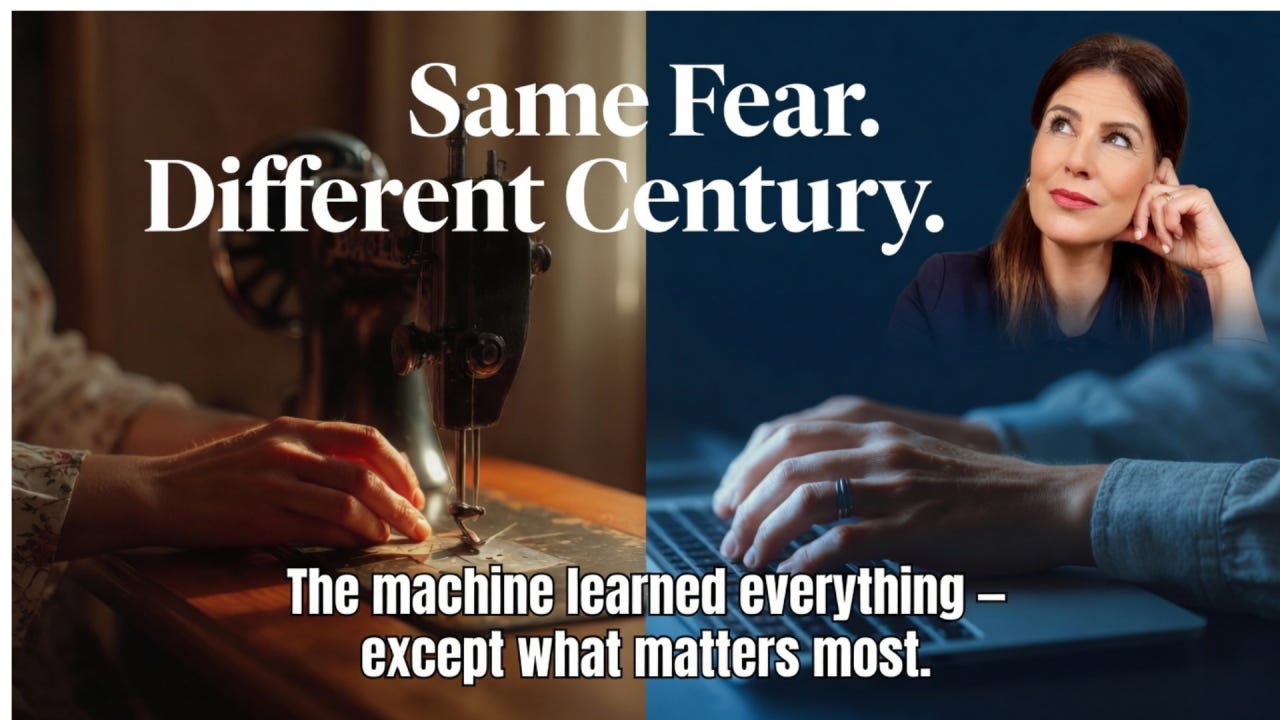
Same Fear. Different Century.
The machine learned everything — except what matters most.

BY TANYA THORSON · MERCHANDISING & MARKETING EXECUTIVE
Last week, Reese Witherspoon posted a video on Instagram. She wasn’t selling anything. She wasn’t announcing a project. She was asking questions.
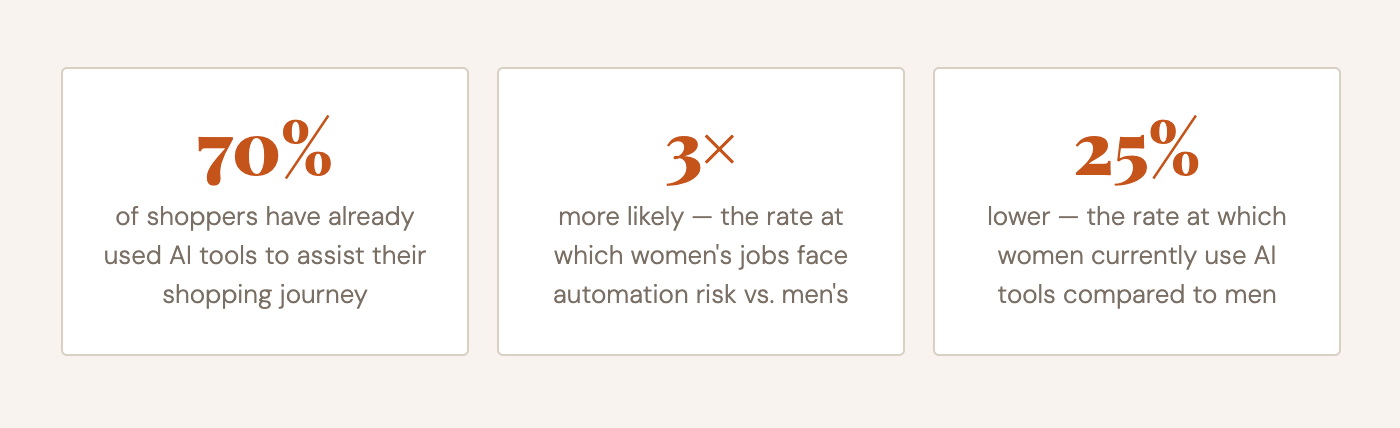
“The AI revolution has begun, and I need to learn as much as I possibly can — and share it with all of you.” She pointed out that women’s jobs are three times more likely to be automated by AI, yet women use AI at a rate 25% lower than men. “We don’t want to be left behind. Do you want to learn with me?”
The backlash was immediate. She was accused of shilling for Big Tech. Of being naive. Of not understanding the stakes.
She responded the way every good leader does when the room turns: she held her ground. “No one is paying me to talk about this. I’m just a curious human.”
I’ve been thinking about that phrase all week. A curious human. Because in thirty years of watching technology reshape retail, fashion, and brand strategy from the inside — curiosity is the only thing that has ever consistently separated the leaders who thrived from the ones who got left behind.
Every generation asks the same question: is this the technology that finally replaces me?
The answer has always been the same. And it’s not the one the financial channels are selling. Not expertise. Not seniority. Not the size of the team or the budget or the title.
Curiosity.
This week I want to talk about what’s actually happening with AI — not the fear version, not the hype version, but the version that a merchant, a marketer, and a strategist sees when she looks at it clearly. Because the story is more interesting, more human, and more familiar than anyone on the financial channels is telling you.
The Sewing Machine Didn’t Kill Fashion. It Created It.
Every generation gets its disruption story. And every generation discovers the same truth on the other side of it.
1850s
Singer’s Sewing Machine
Seamstresses panicked. Hand-stitched garments were dead, everyone said. What actually happened: clothing became accessible to everyone for the first time, an entire fashion industry was born, and the humans who understood design, fit, and the customer didn’t disappear. They became more valuable than ever.
1879
The Department Store — Fixed prices. Ready-made clothing. The death of the tailor, everyone said. What actually happened: the merchants who understood relationship, curation, and the emotional experience of shopping built the most powerful retail empires in history. The task changed. The human judgment compounded.
1974
The Barcode Scanner — First used at a Marsh supermarket in Troy, Ohio. Grocery workers were terrified. What actually happened: checkout got faster, stores got bigger, and the human role shifted from transaction to experience. The stores that understood that built loyalty. The ones that didn’t became commodity.
1994
The Internet — The death of retail, everyone said. What actually happened: the merchants who understood that the internet was a new channel — not a replacement for human judgment — built the most enduring brands of the next thirty years.
2026
Artificial Intelligence — Same headline. Same fear. Same opportunity underneath it — for the people who stay curious.
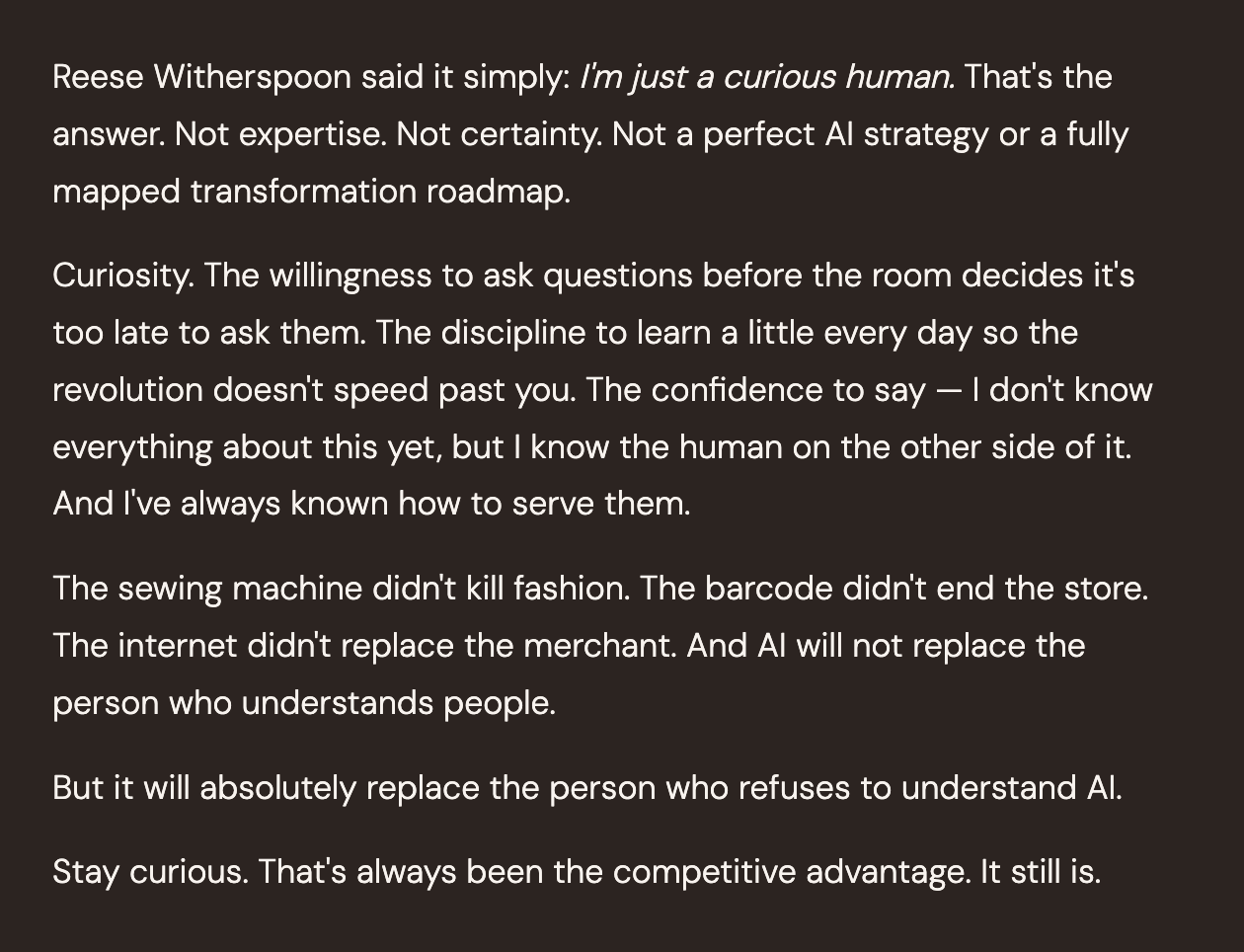
The pattern is always the same: the task automates. The human judgment compounds. Technology has never replaced the merchant. It has always — eventually — made the merchant more powerful.
You can’t automate your way into loyalty.
What AI Actually Does — Right Now, In Retail
Here’s what the merchant’s eye sees when it looks at the AI landscape clearly — not what the financial channels are saying, but what’s actually happening in stores, in supply chains, and in the customer experience right now.
Walmart built an AI agent called Sparky. A parent asks for a meal plan and camping supplies. Sparky checks preferences, inventory, and the weather, suggests a basket with relevant items and sale prices — then completes checkout with a single confirmation. That’s not scary AI. That’s the best associate you’ve ever had, available at 2am, who already knows what you need before you finish asking. I built systems around this belief at Lands’ End and Jockey. The technology changed. The insight didn’t: the customer wants to feel known. Now technology can help deliver that feeling at scale.
The EU Digital Product Passport launches in 2026. Scannable IDs on products — QR code, NFC, or RFID — that tell the full story of how something was made. Every material. Every supplier. Every hand that touched it. At Fair Indigo, we built an entire brand around 97 hands — the humans who grew, spun, cut, sewed, and finished the product. We did it manually, one product at a time, because we believed the story was the value. AI is about to make it possible for every brand to tell that story at the scale of their entire catalog. Technology amplifying the human element — not replacing it. That’s the whole game.
Victoria Beckham launched with Gap this week. Fifteen years of losses. A beauty pivot that saved the brand. And now — 1,800 stores. The 1,000-Day Brand doesn’t always look like winning while it’s happening. But the discipline of those fifteen years is exactly what makes the collaboration credible. AI didn’t build that story. A human who refused to stop did.
The Brands Getting It Right
The most interesting thing happening in retail AI right now isn’t the technology. It’s the philosophy behind how the smartest brands are deploying it.
There is a growing separation between the retailers who treat AI as a cost-reduction tool and the ones who treat it as a brand investment. The first group is optimizing checkout flows and automating customer service scripts. The second group is using AI to become more recognizably, coherently, distinctly themselves — across every screen, every conversation, every touchpoint.
The brands that emerge from this period with real equity won’t be the ones with the most sophisticated AI. They’ll be the ones that used AI to amplify what made them human in the first place.
Pinterest understood this instinctively. At Coachella this year — surrounded by brands competing for attention, content, and clicks — Pinterest did something nobody had ever done at a major festival: they asked people to put their phones away. Lock the devices. Make a charm. Fill out a physical Joy Guide you could mail home. Create a memory, not content.
The most talked-about brand activation at Coachella 2026 was the one that turned the technology off.
That’s not a paradox. That’s the Human Smudge — a concept we explore in 📚 Get Off Your (M)ass! — the quality that can’t be manufactured, templated, or approved by algorithm. The thing that makes a brand unmistakably itself. Pinterest didn’t abandon technology. They understood it well enough to know exactly when to set it aside.
That’s the whole brief. That’s B2A — Business to Anyone™ — applied to the most important question in marketing right now: what does technology make possible, and what does it make necessary?
When AI handles the cognitive drudgery — comparing products, checking inventory, optimizing pricing — it frees the human to do the one thing no algorithm has ever been able to replicate: notice what the customer isn’t saying.
At Lands’ End, I watched a customer hesitate at a swimsuit. Not because the size was wrong. Because she’d had a mastectomy and the market wasn’t serving her. No data set surfaced that insight. A human paying attention did. The mastectomy swim line we built from that moment became one of our most meaningful product decisions — and one of our most loyal customer relationships.
The machine can learn your purchase history. It cannot learn your hesitation.
The POISE Framework in the Age of AI
In 📖 Get Off Your (M)ass!, we built the P.O.I.S.E. framework around one belief: that business, at every level, is conducted between human beings. Technology changes the channel. It doesn’t change the human on the other end of it.
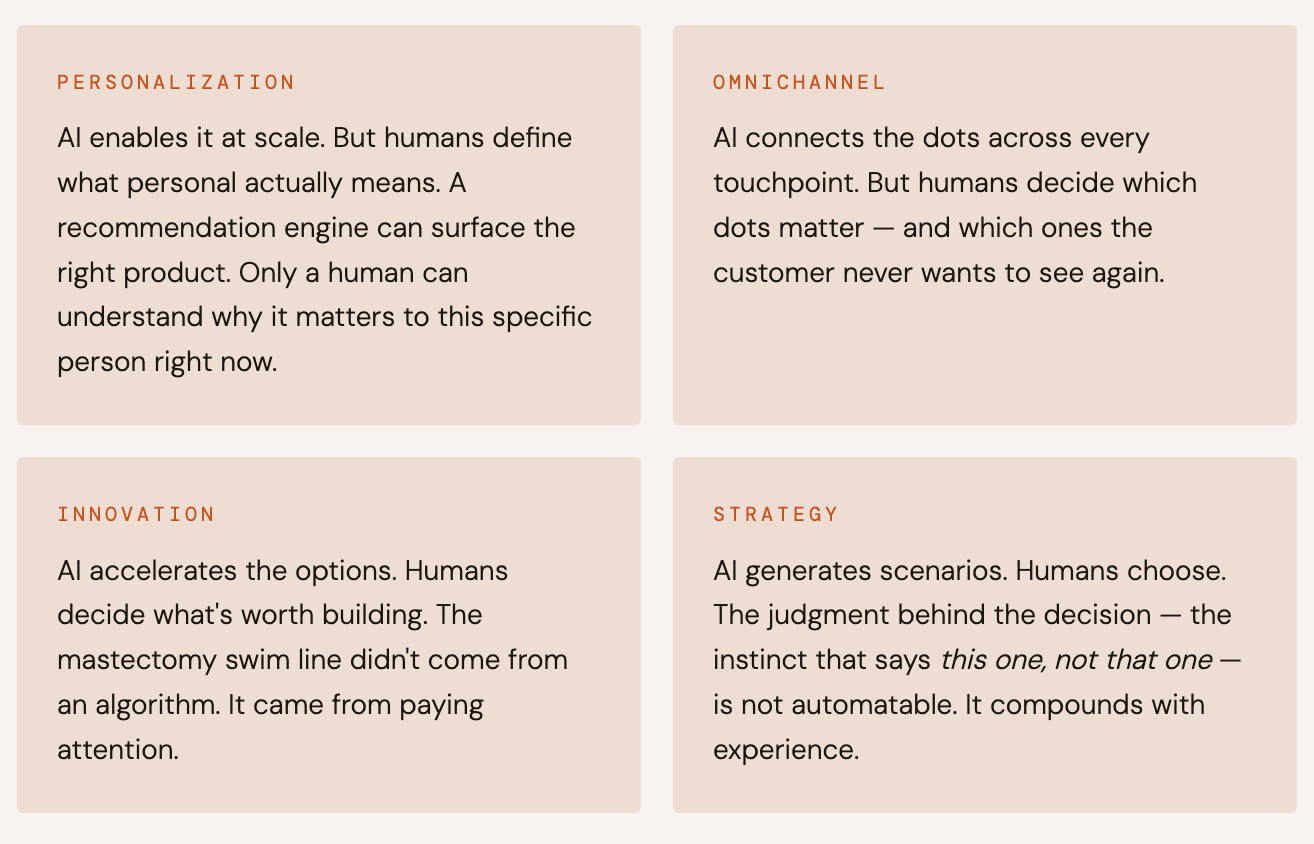
And then there is the fifth pillar — the one no technology touches:
Emotional Intelligence. Full stop. Not automatable. Never will be.
So: What Do You Do With All of This?
This week I published a piece in MarTech on exactly this — why relevance now beats reach in the AI-driven buyer journey, and what that means for how brands show up before the conversation even starts. Link in comments.
And as always — I’d love to know what you’re seeing.
What’s the AI moment in your industry that changed how you thought about your work? Drop it below. I read every one. ☕
Continue the conversation
🗞️ Subscribe to my newsletter for weekly thinking on buyer behavior, brand, and human first growth: ‘https://tanyathorson.substack.com/subscribe
📚Check out our book, Get Off Your (M)ASS! for a deeper dive into Business to Anyone™ and the POISE framework: - 📚 Paperback: https://tinyurl.com/2y8pusve- 📖 Kindle: https://tinyurl.com/4yxea9hd
Let’s connect if you are rethinking how merchandising, marketing, product, and growth should actually work together: 📧 tanyalynnthorson@gmail.com | 📞 (614) 313‑1345
Curiosity...!!! What a great history lesson and reminder...!!! Context. Perspective. Take a deep breath and be curious...!!!